
On March 9 I went to the launch a new initiative called The Brisbane Dialogues, which is intended to combat the following problem:
Polarisation and toxic discourse – old-fashioned intolerance and incivility on 21st century steroids – should be everyone’s concern. It’s not just in the public arena and not just online, they are seeping through everywhere, affecting day-to-day life and making it near-impossible to have productive discussions about the enormous challenges – and opportunities – facing humanity.
With a few reservations (which I’ll try to explain), I am very glad to see this happening. I hope that the organisation will get popular support, I hope that I can be involved, and I hope that with some experimentation they can find some solutions that work well in our community. And contra the impression one might get from what I’m about to say, I did enjoy and learn from the event, and I’m sure that most who went feel the same way. I offer what follows in a spirit of constructive criticism.
The Dialogue Solutions:
As far as I can tell from the evening’s speeches and the organisation’s promotional material, the solution offered by TBD at the moment is a mixture of politeness and allowing ‘both sides of the story’ a hearing. (I do get the impression that they are willing to look at other options, too.) In this spirit, the main feature of the event was a debate between Prof John Quiggin and Prof Stephen Hicks on the topic ‘Postmodernism is a right wing philosophy’. Former Nationals leader John Anderson seems to be a bit of a patron saint of the new organisation – he is quoted on the promotional material and even delivered a video message to the audience at the start. (As far as I can tell, he is quite committed to the politeness solution to the problem of political dialogue, but not so much to the idea of giving a platform to the views one disagrees with, inviting to his podcast and videos more-or-less exclusively people who he sees as helping him to amplify his own message – though this need not be people who he strictly agrees with. This inconsistency may seem a little frustrating, but given that I have elsewhere expressed a wish that more moderate conservative voices would come forward to compete with the dangerously reactionary ideas around at the moment, I won’t complain about what he is doing there. Anyway…)
Are politeness and ‘both sides’ the answers?
Not the whole answer at least, and I think a few key moments from the debate between Quiggin and Hicks can help to illustrate this.
First, it is worth considering the debate topic – this rang alarm bells for me as soon as I saw it, and it turns out that I was not at all alone in feeling this way. One of the biggest problems driving the rise of polarisation and toxic discourse is surely the widespread mistake of thinking that civic engagement consists in adopting a left-wing or right-wing identity, and then going in to fight for one’s side, come what may. Having seen the debate, it is still not at all clear to me that there is any use in ascribing postmodernism to the left or the right, and more importantly this sort of discussion seems to reinforce the notion that the two camps must or should have such substantive features as their own ways of believing, their own intellectual traditions, etc.
This is relevant to the use of a ‘both sides’ solution to the problem of toxic discourse – I am not sure that ‘both sides’ is of much help unless the sides are well chosen and have something useful to contribute, and left-v-right, for many reasons, doesn’t qualify. Quiggin was apparently the one who proposed the left-v-right topic, but then was hoist with his own petard when he had to listen patiently and respond politely to several minutes of ‘right wing’ views on climate change: e.g. that it’s insulting to call people ‘deniers’, plenty of non-scientists can see that the science is actually quite weak, +2C over 100 years might actually be quite nice, etc., etc. I have read enough of his online commentary on the climate wars to suspect that he didn’t enjoy this bit of the evening.
On the topic of the climate discussion: I know that some people were annoyed by Hick’s appeal to his academic qualifications here in lieu of argument. Now, I do think in this particular case that the appeal did not work (I think he was referring to his doctoral thesis ‘Foundationalism and the Genesis of Justification’). But the complaint seems to be more general in character, rejecting the idea that an expert can assert authority without providing their reasoning. As I’ll try to show, I think it’s not so simple.
A questioner from the audience asked Hicks and Quiggin about deplatforming. Both were in furious agreement that this is a bad thing – Hicks citing campus protests in the US and Quiggin citing threats against journalists by Trump supporters. But simply rejecting deplatforming in principle is moving too fast. Universities, for example, have preferential platforming built into their institutional DNA – the day they stop deplatforming people is the day that they cease to be universities. As Bernard Williams put it:
. . . in institutions that are expressly dedicated to finding out the truth, such as universities, research institutes, and courts of law, speech is not at all unregulated. People cannot come in from outside, speak when they feel like it, make endless irrelevant, or insulting, interventions, and so on; they cannot invoke a right to do so, and no-one thinks that things would go better in the direction of truth if they could. (Truth and Truthfulness, p217; cited by O’Neill in ‘Ethics for Communication?’)
Hicks and Quiggin were both on that stage because they had been judged worthy of a platform, knowing that if they badly bungled it they likely wouldn’t be invited again.
The problem, as far as I can tell, is not that people are increasingly being robbed of their chance to have their say, but rather that disagreement has grown about who is acting in good faith and who has any good reasons at all behind their claims (who deserves a platform). One solution would be to allow everyone their moment on a pedestal and let them pass or fail the test of publicly revealing their competence. But there is a problem with this solution – humankind’s store of knowledge and know-how is so great now that it is impossible for anyone to master even a decent fraction of it. To a large extent, wise decision-making is not just about knowing how to think logically, but knowing who to trust, as we cannot possibly think through everything for ourselves. (Imagine learning about general relativity for the first time without some assurance that it was a ‘serious idea’, approved of by experts.) So, other methods must be found for policing quality of contribution, such as the peer-review system, and these function to greater or lesser extents, but importantly they tend to rely on the existence of a pool of expertise, and they help to decide who gets a platform.
Of course, The Brisbane Dialogues is not a university or law court, and its stated purpose is not to find the truth but to resolve a social problem. But I think that there is a very relevant lesson in all of this still. That is that many of the causes of polarisation and toxic discourse result from the use, not the absence, of informal methods of policing productive and good-faith dialogue. These practices (moralising, accusing, deplatforming, deferring to experts,…) are important tools in social discourse, but they only work when we can roughly agree on how they should be applied. (There is, at least, a close analogy here with the problem of what is called ‘anti-social punishment’, but I won’t expand on that here.)
So, in summary: a solution to the problem of polarisation and toxic discourse should not reinforce existing social categories which largely function as barriers to dialogue; it must be prepared to police norms of discourse which tend towards productive discussion (and politeness alone is not at all sufficient here); it must be able to accommodate a society-wide division of cognitive labour, and so the role of (genuine) expertise. I don’t pretend that any of this is easy, hence my earlier references to ‘experimenting’ with solutions.
So who won the debate?
Well, it depends on what we take to be at stake, how we interpret the question. Quiggin I think gave a more compelling account of the history of postmodernism and what drives people to embrace it, Hicks was at his best when downplaying the substance of notions of political left and right outside their narrow traditional domain – an important point here I think.
Again, I often found the agreement points more contentious than the disagreements. Both claimed to be defenders of the legacy of the Enlightenment, but there was at best an embarrassed silence regarding many features of this, including prominently the Scottish Enlightenment. I say at best because Quiggin repeatedly called Edmund Burke a postmodernist and Hicks levelled the same accusation at John Gray (as well as seeming to imply that Gray is on the political far-left). But even on the broadest plausible construal of ‘postmodernism’, these claims are certainly false, and both speakers seem to be making a roughly similar error here. Both seemed to be rejecting one of the great achievements of the Enlightenment: That is, reason overcoming Cartesian rationalism and similar errors to discover its own limits, a process which culminated in the work of either Hume or Kant, depending on who you believe. (Or culminating in Hegel, if you’re a ‘postmodernist’.) If a postmodernist is anyone who won’t give absolute priority to episteme over techné and phronesis, then modernism is indeed in deep trouble, and I’m happy to see it go.
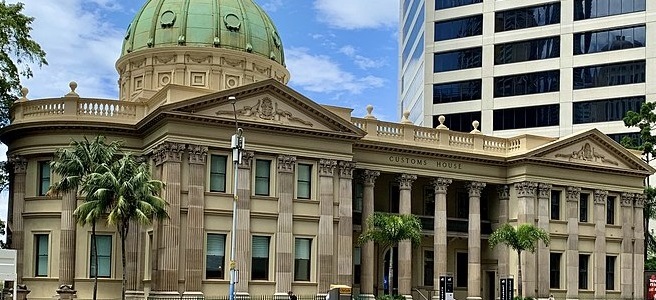
Image: detail of Customs House, Brisbane, Queensland, 2019 by Kgbo / CC BY-SA (https://creativecommons.org/licenses/by-sa/4.0)
 The ArachneanMetaxion Point