I want to highlight a difference in public comments on the terrorist attack in Christchurch which I think deserves comment. (This was actually written shortly after the attack occurred, but I’m just getting around to posting it now unfortunately…)
One type of response is typified by the hashtag #thisisnotus, which became popular in the hours after the attacks. (There was an identical hashtag, and similar backlash against it, after the violence in Charlottesville in the US.) This seeks to treat the attack as an utterly alien phenomenon, motivated by a sort of evil which is both exceptional and inexplicable. ‘This sort of thing is unthinkable, because this is not at all what we are like.’
The second response is to draw links between this apparent anomaly and more familiar phenomena. We see this when the attack is likened to other racist acts which have occurred, or to patterns of racism in New Zealand or Australia (the attacker and some of his supporters being Australian). One opinion piece suggested that the terrorist “is not an aberration, he’s not an exception; he is an integral part of the collective “we” in New Zealand, Australia, and the “West””. We also see it, from a slightly different angle, when reporting on the attacker focuses on his childhood, past employment, hobbies (other than videogames, oddly), and travels, and these are seen to be relatable and relatively normal.
I do not think it is interesting to ask which of these angles gives us the ‘true’ picture of the attack, as I have no doubt that either could produce a very true picture – both have plenty of facts to draw on. I am very interested in what the responsible attitude to take is, which does not mean simply reporting the facts but also expressing a stance, and so deciding which facts deserve to be emphasised.
In cases of more banal wrongdoing, there are two important points to consider here. One is the risk of ‘normalising’ bad behaviour. There is a line of research stretching from Cialdini et al. 1990 to ongoing work by Cristina Bicchieri which demonstrates the danger of signalling that ‘the rule against x is not being observed anymore’. Even if we continue to insist that the social norm against x is an appropriate one, we undermine the norm by suggesting (whether sincerely or not) that it is widely ignored – it will cease to have the sort of power over people’s consciences that it formerly had. The second concern is the risk of driving someone completely outside of the moral community – if we are too zealous or holistic in our denunciations, we may leave a person who has broken a rule feeling that they have been completely ostracised from the community, and have less reason to seek the approval and conform to the expectations of those in it. This is the risk that moralising will do more harm than good. (I am thinking primarily of the work of John Braithwaite on ‘reintegrative shaming’ here.)
These are the concerns that must be balance when responding to a behaviour like littering (Cialdini et al.’s example) – we want to stress that the behaviour is unusual and unwanted, but that the individual can still have proper standing in the community and so has reasons of social standing to change their behaviour. It is not unusual to extend this sort of thinking all the way up to discussions of violence. But the terrorist attack in Christchurch is not like this. The attacker has basically declared his complete divorce from the community through his actions and his manifesto, and will hopefully never be allowed out of jail again anyway. There is really nothing to gain from offering him reintegration – the focus must overwhelmingly be on denouncing the action and stressing that this sort of thing is not normal, and that we wish see the norms against this behaviour strengthened rather than weakened in response to this atrocity.
The key idea here, as I’ve already hinted, is normalisation: what sorts of things do we want to treat as normal and abnormal? People who hang around university humanities departments (i.e. probably a decent percentage of those reading this) are prone to see themselves as outsiders of one sort or another – either misunderstood weirdoes or learned authorities, or both – and so this does not immediately strike them as an obvious concern. But the evidence suggests otherwise. Acting morally is, for most people, largely a matter of remaining near the top of certain bell curves, while seeking clues from one’s community members that will help one to ascertain where the top of the bell curves actually are and what degrees of deviation will be tolerated in their specific case. And in the same way, they seek clues regarding what degrees of deviation they should be willing to tolerate from others.
One thing that is particularly troubling about the ‘this is us’ sort of response is that there is a lot of pressure on the norm against overt racism already, coming from a different direction. Witness some of the reactions from politicians to the Charlottesville and Christchurch attacks. If the loudest voices across the political spectrum are all calling this normal behaviour, it will take exceptional levels of independent thinking from those who are not the targets of these attacks to maintain the appropriate level of moral disgust at them.
Of course there is a stark difference between those saying ‘this is us’. Some people who ‘normalise’ the attack are trying to draw attention to problems in our society, while others are trying to deflect attention from them or even exacerbate them, and I could be accused here of conflating two very different sorts of behaviour. I think there is not much to say on this issue except that good intentions only get us so far. I’m certainly more sympathetic to one camp than the other. But given that none of us can expect our message to be understood and accepted in whole and without qualification, we just have to try to consider our audience and what they will actually take away from what we communicate (particularly what we communicate widely and haphazardly across social media etc.) – good intentions aren’t enough. Some readers may have already noticed a similarity between what I am describing and the alleged ‘Overton window’ of political discourse – what I seek to stress is that we may shift ‘Overton windows’ in the wrong direction unintentionally – this point does not seem to be stressed enough.
I want to end with three examples, so that what I am saying will not be misread as an attempt to excessively narrow the range of appropriate responses to something like the Christchurch attack.
I think that Waleed Aly’s public response to the attack managed to very neatly avoid the problem of normalisation that I have highlighted here. This is despite his emphasising and repeating the phrase ‘I am not shocked’ – which prima facie seems like exactly the sort of statement I am trying to dissuade people from making. What makes Aly’s use of the phrase effective, I take it, is that the phrase itself is shocking (and clearly delivered with this intention) – the viewer is shocked into listening carefully to someone who has been a target of racism and has closely followed developments on this front in the community. (A target of everything from the callous and thoughtless sort, to the extreme sort: There are surely few figures more publicly and vocally hated by the Australian far right than Aly – expressing hatred for him specifically is something like a meme of theirs.) The point, I take it, is not that the attack is less shocking than day-to-day racist acts or institutions, but that it largely grew out them, and could have been stopped, perhaps, if we all had been paying more attention. The message is ‘this was bound to happen’, not ‘this happens every day’.
Second, a ‘pyramid of white supremacy’ picture has been circulating on social media. The image suggests a relationship between extreme violence and the the sort of racism (institutional and attitudinal) with which we are all, unfortunately, very familiar. But importantly, it does not equate the two in terms of severity or normality; indeed, the reverse is made explicit. My critique here would only apply to a diagram like the pyramid in which the ordering of the acts or attitudes is rearranged so that the intuitive order of severity is subverted, and normal people are encouraged to see their own behaviour as more or less severely wrong than they realised. This is doubtless done with the very best intentions, but the effect is to weaken the norm against racism, as the reader feels that the appeal to moral outrage (at the top of the pyramid is genocide!) has been made in a calculating and cynical way. I have seen examples of pyramid-style diagrams (versions of the ‘iceberg’ meme) on social media which strike me as likely to have this effect, but I will leave it to the reader to form their own opinion about when the sort of line that I am sketching has been crossed.
Third, I see what I am saying here as related to a recent article in The Conversation (perhaps the author would disagree). Here, normalisation is presented as one of the risks posed by the willingness of public figures to flirt with extremist ideas – it seems like support for the extremist, if perhaps only tacit (or ironic) support. I wish instead to highlight the risks created by even those who see themselves as most stringently opposing the extremist, when they are tempted by the chance to hyper-moralise a more everyday sort of wrong during a moment of moral panic. This is not a moral error of the sort that Barton calls out, but it is a mistake with important sociological parallels, I think.
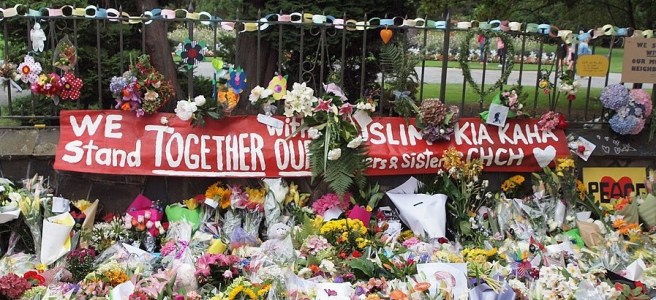
[image: We Stand Together by James Dann [CC BY-SA 4.0 (https://creativecommons.org/licenses/by-sa/4.0)%5D%5D
 The ArachneanMetaxion Point