

What is morality, if not the positive morality studied by anthropologists and their kind? For some this will seem like a daft question: obviously positive morality is to be contrasted with normative morality, the latter of which is the subject of moral philosophy. Isn’t that what we have the is/ought distinction for? I think that this is a mistake. What has traditionally insulated the moral philosopher from social and behavioural science is not the distinct logical significances of ‘is’ and ‘ought’, but a much more arbitrary and haphazard disciplinary boundary in academia. Moral philosophers may continue to prop up this boundary if they want to, but if they do so then they should recognise that they are writing only for each other.
What follows is a write-up of a presentation which I gave at the AAP Conference 2019.[i] It is intended as a introduction to and partial defence of a ‘rational reconstruction’ approach to moral philosophy. The structure is a little non-linear – I first describe rational reconstruction by contrasting it with some other approaches to moral philosophy, then present a model for teaching complex accounts of morality (rational reconstructionist, and others), then finally demonstrate some problems for contemporary moral philosophers to engage with which my model helps to illustrate but which seem to fly under the radar of 20thC analytic approaches to moral philosophy.
Theorist-Centric versus Rational Reconstruction Accounts of Moral Philosophy
All of us encountered morality before we encountered formal philosophy.[ii] If we started out wondering about the nature, truth, or legitimacy of morality, we were wondering about what I will call ‘folk-morality’: morality as a social-psychological phenomenon, or a phenomenological one, or spiritual one, or a folk-metaphysical one. We were wondering about positive morality, or at least some aspect of it. However it is easy, within a university environment, to get drawn into thinking that morality and moral philosophy are basically the same thing, and that folk-morality is a sort of poor imitation of these. Take these examples, one of which was written for a public audience, the other written for an academic audience, concerning the meaning of the term ‘ethic(s)’:
“Ethics [as distinct from morality and law] is a branch of philosophy that aims to answer the basic question, “What should I do?”… Christians, consequentialists, Buddhists, Stoics and the rest all provide different answers to that question, “What should I do?” Each of these answers is a ‘morality’.” (‘Ethics, Morality, Law – What’s The Difference?’ The Ethics Centre’s blog, Sept 2016, emphasis mine.)
“As we noticed (an) ethic is ambiguous, as between a specific ethical system, a specific ethic, and a more generic notion, a super ethic, under which specific ethics clusters. An ethical system S is, near enough, a propositional system (i.e. a structured set of propositions) or theory which includes (like individuals of a theory) a set of values and (like postulates of a theory) a set of general evaluative judgments concerning conduct, typically of what is obligatory, permissible and wrong, of what are rights, what is valued, and so forth. A general or lawlike proposition of a system is a principle; and certainly if systems S1 and S2 contain different principles, then they are different systems.” (Sylvan, ‘Is There a Need for a New, an Environmental, Ethic?’ 19-20, emphasis and parenthesis in original.)
This is one sort of ‘theorist-centric’ approach to understanding morality or ethics (I do not think that the terms are best understood as interchangeable, but the differences are not important for the moment). It suggests that applied ethicists are asking the right sorts of questions, and can expect to find the right answers.
Another popular approach to understanding morality is to ask “What is the illocutionary force of the claim ‘x is bad’?” (Or, ‘x is wrong’, ‘x is good’, etc.) This is certainly taking a step back from the disciplinary norms of applied ethics, and indeed the results of this enquiry might have consequences for the practice of applied ethics. The question might be translated to: “What is the language game of morality?” But then the problem becomes immediately apparent – if we are talking about folk-morality here, then there are many, many language games of morality. What is there for the philosopher to contribute, that the anthropologist cannot? The search, it seems, is for the privileged illocutionary force(s) of a moral claim: the essential ones(s). This was the mission of much of 20th Century analytic metaethics. Here are three potential answers:
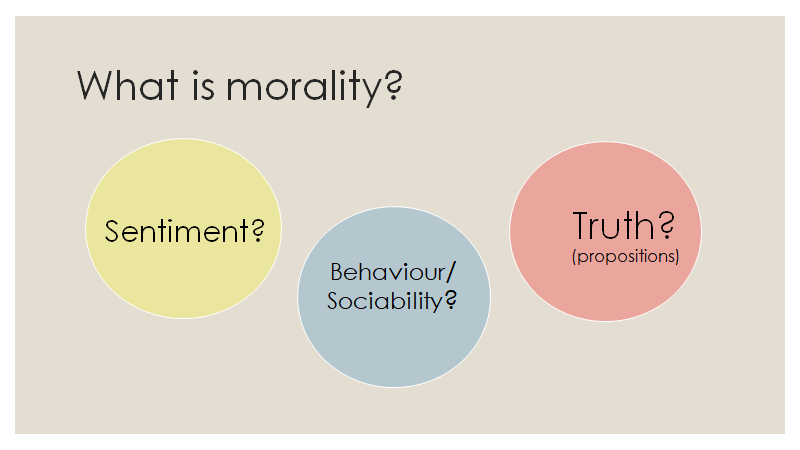
Obviously these are not the only options. But they’ll do for our purposes (i.e., we will return to them). The ‘cognitivist’ school says that moral claims are or relate to propositions. The ‘emotivists’ emphasise the affective nature of morality: at the root of morality sits emotional empathy, the reactive attitudes, and/or the importance of happiness in a valuable life –other topics might supervene on this. The third category, under which I place everyone from behaviourists to neo-Aristotelians, sees the defining feature of morality as its importance in allowing us to live together peacefully and productively, with the mental events related to this being of only secondary concern.
Plenty of ink has been spilled defending one or another species of reductionist metaethical view from its rivals. But here is an alternate project for the moral philosopher: to first understand folk-morality in all of its complexity and oddity, and then to get to work on the project of determining whether this is a phenomenon which we want to remain involved in, or what must change for it to continue to make sense to us or for it to continue to ‘work’.
I’ll call this a ‘rational reconstruction’ approach,[iii] following Imre Lakatos’s analogous approach to the philosophy of science. We can talk about science as if it is just a lot of different people in different rooms doing randomised controlled trials (which is the account of science I learned in high school). Or, we can think of it as a very complex social, institutional, epistemological phenomenon which takes a lot of effort to understand (and only part of this is understanding what happens when a lot of different people in different rooms are doing RCTs). The rational reconstruction approach does not start out which such a strict sense of what is essential to a practice and what is contingent or peripheral, and nor does it aim to end up with such a reductionist conclusion. Ultimately, though, there is room within it for critique – identifying inconsistencies, incongruities, or even some critical challenge for the system as a whole. I will try to illustrate this a bit towards the end.
A Tangent on Teaching
There is an apparent barrier to the rational reconstruction approach which I want to discuss here, and in the process I can hopefully help advance the wider topic as well. Simplicity and contrastability are at least implicitly recognised as hugely important theoretical virtues in the contemporary practice of philosophy. Ideas need to be simple enough to fit into a standard-gauge intuition pump, and they must relate to other ideas in such a way that the agreements and fault lines are identifiable and at least usually uncontroversial. If what I am proposing lacks these virtues, then whatever other virtues it has, philosophers will find it hard to incorporate into their practice.[iv] Hence the following model, which is prima facie only a little more complex than asking students to choose between, say, the big 20thC schools of metaethics:
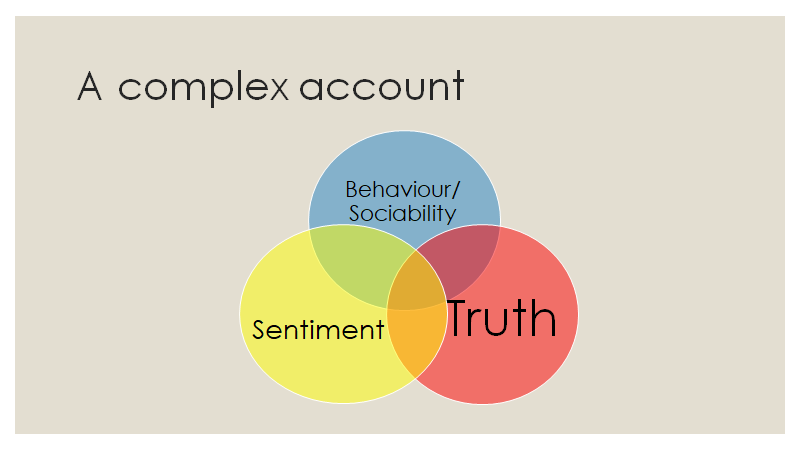
Again, this is designed as a teaching aid. We can start out at any of these outside points, and discuss whether or not the primary colour is sufficient for an account of what morality/ethics is, and if not, whether the extra needed draws us into one of the other fields. There is no real minimum level of experience in philosophy needed in order to do this – we could be discussing purely pre-reflective folk-morality, or we could be discussing the views of someone who has formed opinions on common topics of moral philosophy.
To give one example of how such a conversation might proceed: we might start out with the view that morality is ‘a structured set of propositions’, and so it is to be found in the red zone. There is a familiar problem with this idea: the facts that compose morality seem to be facts with ‘funny properties’ – they are not just true, they have a sort of action-guidingness which is peculiar to moral facts. Now one response to this which seems to me the most promising (the reader needn’t agree) is to introduce emotion here. It is getting harder and harder to ignore the role of emotion in our ability to function – a relatively minor anomaly in our emotional reactions could leave us unable to function as a moral agent,[v] a more severe lack of emotion may leave us barely able to function as an agent at all. So, there is some case for moving our focus to the orange zone. From here, we can discuss whether there is any case for including sociability as an essential element of our account – this could relate to what makes a moral proposition true, or to the character of the specific emotions which have been identified as important.
Of course, the reverse sort of trajectory is possible too: We can discuss, for example, a Stoic moral schema with reference to this model, which is suspicious of both the role of emotion and sociability in shaping character, and so keen to avoid the centre of the model.
This brings me to a second use of the model, which is illustrating the thought of historic greats of moral philosophy. We can try to locate important thinkers on this diagram, the paths that their arguments take. Take the example of Hume:

It is common here to start out with his ‘emotivist’ account of moral judgement. But sociability plays a huge role in his account: our example here can be the notion of ‘artificial virtues’ like justice. Finally in examples like the excerpt from ‘On Suicide’ here, we see Hume manipulating moral claims as if the are propositions. Clearly Hume is not a crude emotivist, but each of the shifts presented here seems to require explanation – how are the claims consistent with each other? By using the distinctions of Figure 1, but allowing the possibility that the primary coloured sections might complement rather than conflict with each other, we can tell a story about Hume’s thought which gets the benefits of simple concepts, but does not mislead students into seeing his view as a reductionist one.
Hume’s approach to moral philosophy was more-or-less what I have called ‘rational reconstruction’. But very different thinkers can fruitfully be modelled here too, provided that their views are sufficiently complex. Take the following example, from Kant: We start with a notion of morality in the red zone ‘[c]ompletely cleansed of everything that may be only empirical and that belongs to anthropology’ (4:389). But very quickly we find ourselves discussing interpersonal (social) dynamics in the purple zone: “There is only one innate right… Freedom (independence from being constrained by another’s choice), insofar as it can coexist with the freedom of every other in accordance with a universal law” (6:237, my emphasis). How does Kant relate to the centre of the diagram? Here we can talk of how Kant saw moral truth relating to moral practice, or how neo-Kantians have responded to developments in moral psychology since Kant’s time.
The value of this, I think, is not that I have identified three essential building blocks of moral philosophy, for the Venn diagram could certainly be altered to prioritise different topics. The value is that it harnesses the sort of simple taxonomies and controversies which teachers of philosophy love, but directs them into a model which illustrates agreement as well as disagreement – it allows for discussion of moral philosophy in such a way that very different ideas can be discussed, without a sense that the parties are merely talking past each other, using terms like ‘morality’ and ‘ethics’ in novel and purely technical ways.
In a similar vein, an assessment task can be created which allows for disagreement without necessarily pushing students into radically opposed and mutually incompatible camps. Here is one attempt at such an essay question:
- When trying to understand morality, should we start:
- with facts about what is right and wrong;
- with feelings (emotions) like moral offence, blame, and admiration; or
- with the needs of human sociability?
As should be clear, a reductionist answer is possible here, but not required. Note that ‘where to start?’ is an ambiguous question, suggesting perhaps a search for a necessary and sufficient condition, or for a frame of reference from which to understand a bigger picture, or perhaps for something like what Bernard Williams called the (Hobbesian) ‘first political question’ (In The Beginning Was the Deed, Chapter 1). I take this to be a feature, not a bug, of the question.
The Moral Philosopher as Rational Reconstructer
It will probably not come as much of a surprise by now if I say that I think something important is happening around the centre of my model. Morality is historically an emotional, sociable, and codifiable system of practices and beliefs. Not only this, but I think that after rational reconstruction and reflection we will find that we have good reason to continue to embrace much of positive morality.
Of course, there is nothing in-principle wrong with creating a structured set of propositional ought-claims, and indeed this might turn out to be a very productive activity. The problem arises when philosophers call their system ‘morality’, and fail to distinguish this from folk-morality. Philosophers are human, as are their readers. Practically all humans live their lives firmly in the grip of folk-morality; this situation is remarkably hard to escape, and I happen to think it is also actually quite a good thing (though I have not argued for this here). So, a reckoning awaits the theory-centric moral philosopher, in that their theory must ultimately be compared to folk-morality, and if found wanting by this standard then it must be justified. Philosophers have plenty of defence mechanisms against this danger. Perhaps most prominently, they incorporate ‘intuitions’ as premises in their arguments to ensure safe conclusions, and they leave space for a difference between truth and practice (this is particularly visible when they are parenting, for example).
My proposal is for a bit more self-awareness on this front. The moral philosopher’s job, I think, is to help us to navigate folk-morality, and to help us reform it when appropriate. Here are a few of what I take to be the implications of this (though the arguments for these are obviously underdeveloped here):
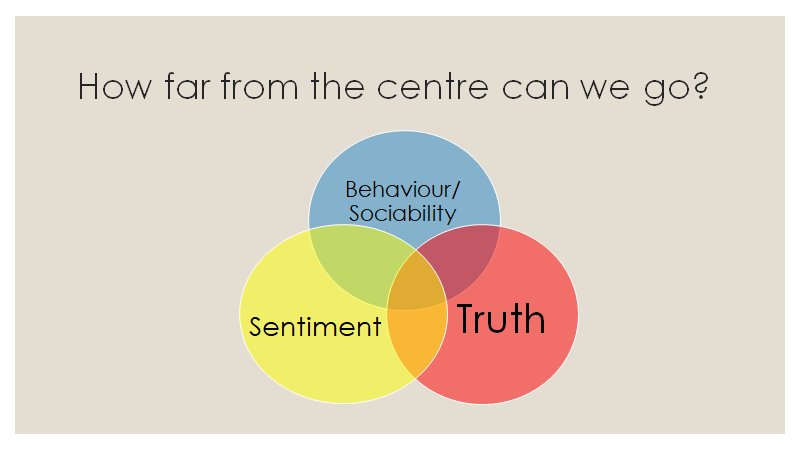
Value is something we do: As hinted, I think that we can consider the plain-red section of my Venn diagram as deeply problematic. We might well begin here, but if we end here we have not made much progress. I take this to be Richard Joyce’s mistake when he concludes that morality is a fiction: he begins by examining only the most cognitivist aspects of folk-morality, and refuses to let other aspects of it inform the analysis. Stuck in a holding pattern in the far south-east of my model, there is nothing for him to conclude but that morality is in some sense a mistake.
Morality is resistant, but not impervious, to reason: They say ‘follow the argument where it leads’ – but if your argument leads you somewhere ridiculous, then you may have a nice argument, but you don’t have a new morality. That said, there is a role for reason in identifying and adjudicating inconsistencies in morality, which may create opportunities for innovation. Most people are not emotionally invested in the law of excluded middle or the Texas sharpshooter fallacy. They do, however, care about hypocrisy and treating like cases alike – so reason can be used to point out the inconsistencies which are important to people and which seemingly must (once pointed out) be addressed.
Innovation risks creating disgust, disagreement, and disengagement: We shouldn’t shy away from accepting that these are some of the results of philosophical work, if we are lucky enough for our work to be influential. Disgust is a well-documented response to moral disagreement, due to this disagreement being misdiagnosed as wilful ignorance or trouble-making (I am following the psychological literature on ‘naïve realism’ here). Disagreement is the predictable outcome of numerous people abandoning tradition to try to reason their way to a better account of what is right or wrong. A benefit of this is that some might find better answers to moral problems; a cost is the loss of the social capital that agreement gave us. Finally, disengagement seems to be one predictable response to disagreement. If we are pulled in different directions by folk-morality and theoretic-morality, or by a variety of folk-moralities and theories, then one sensible response seems to be to weigh all of them less in our decision-making – to let the normative force of each cancel out that of the others.
I think that theorist-centric approaches systematically downplay the importance of these dangers of innovation, largely because they seek to optimistically leap beyond disagreement, and because they want a degree of value-monism which moral innovators cannot lay claim to.
Some Problems a Complex Model Confronts Us With
I earlier suggested a question suited to undergrad students, now I want to briefly mention two which I think confront contemporary moral philosophy at every level of sophistication.
First: Can morality be broadened to incorporate ecosystems, even the global ecosystem, such that either morality is no longer centrally a social thing or that we are in some sense in society with our environment? This seems like an urgent question for at least anyone who wants to move beyond ‘instrumentalist’ environmental ethics, and likely those whose considered view of the environment is instrumentalist but who don’t see instrumentalism as an adequate public morality (‘government house instrumentalists’).
Second: In what senses can AI be ethical, given that it is unlikely to have emotions that are exactly like ours? Obviously some sorts of AI will be able to imitate human morality, but what would it take for AI to do the real thing? And as our interactions with such beings come to replace our interactions with other people, what will this mean for the practice of morality (by which of course I mean folk-morality)?
It is worth noting that I think both of these problems have been forced on us by the trajectory history has taken. Innovation is not just something we do because we feel that current arrangements are unfair or could be improved (though radical unfairness is an excellent reason for innovation). Sometimes change is unavoidable, and we are lucky if we can have some advance notice telling us what sorts of changes are underway and how we can try to work towards a good outcome. These are real and pressing philosophical moral problems – much more so than trolley problems or reductionist questions about language games.
[i] I am very grateful to attendees there, at an earlier version at the APPC Monash 2018, and at versions of this talk at UQ St Lucia and ACU Banyo, for their feedback on this.
[ii] I must acknowledge here the huge influence of Gerald Gaus’s work on my thinking. What I have here is maybe not what he would say, but the resemblance to passages like the following is not coincidence: “Unless our analysis of “true morality” connects up with what actual agents see as morality, our philosophical reflections will not address our pretheoretical worries. We come to philosophy worried about the nature of morality, moral relations between free and equal people, and the justification of moral claims. If we develop a philosophical account of morality that tells us what is “right and wrong” that treats moral and conventional rules the same, or sees morality as just another form of prudence, or insists that morality is entirely a matter of reason and so emotion is simply a threat to sound moral judgment – then our account is too far distant from our actual moral concepts to enlighten us about our initial concerns.” (The Order of Public Reason , 174)
[iii] I take it that I am following Fred D’Agostino’s use of the term here, who I turn is using Lakatos’s (rather than e.g. Habermas’s use of the term).
[iv] Again I need to acknowledge a debt to Gaus’s work here: he pre-empts objections to his book The Order of Public Reason as follows: “I am aware, though, that because hedgehogosity is so firmly ingrained in philosophers’ minds, unless one’s work fits into a hedgehog category, it is unlikely that anyone will pay much attention to it. (How can it be taught? Where do we put it in our syllabus? Is it really philosophy?)” (OPR, xv)
[v] By this I mean, for example, the family of traits that are or used to be diagnosed as psychopathy. To us an excellent metaphor for the problem: “The first abnormality appears in the limbic system, the set of brain structures involved in, among other things, processing emotions. In a psychopath’s brain, this area contains less gray matter. “It’s like a weaker muscle,” [Kent] Kiehl says. A psychopath may understand, intellectually, that what he is doing is wrong, but he doesn’t feel it. “Psychopaths know the words but not the music” is how Kiehl describes it.” (Barbara Bradley Hagerty ‘When Your Child Is a Psychopath’ The Atlantic)
 The ArachneanMetaxion Point